
Retaining Wall Builder in Fond du Lac, WI: Three Systems and the Site That Picks One
Three different walls can solve the same slope, and choosing between them is most of what a retaining wall builder in Fond du Lac, WI, is actually hired for.
The grade change, the load above it and what the soil does through a Wisconsin winter decide which one belongs on a property, and that decision gets made standing on the site rather than looking at a catalog.
Stuart’s Landscaping has spent nearly 40 years building retaining walls across Fond du Lac, Green Lake and the greater Fox Valley, and builds them three different ways: in natural Wisconsin stone, in engineered segmental block and in vegetated Envirolok systems.
The team recommends a system only after reviewing the site itself, because each one earns its place on a different kind of slope.
Related: What a Retaining Wall in Fond du Lac, WI, Can Do for Your Property
When Does a Natural Wisconsin Stone Retaining Wall Make Sense?
A natural Wisconsin stone retaining wall makes sense where the look carries as much weight as the structure and the grade change is moderate.
Wisconsin granite boulders read rustic and organic. Chilton limestone brings warm earthy tones and texture, and Lannon stone sits cleaner and more classic.
All three are quarried regionally, which is part of why a stone wall tends to settle into a Fox Valley property rather than sit on it.
What Changes With an Engineered Segmental Block Wall?
An engineered segmental block wall adds capacity, carrying higher loads and larger spans than a stacked stone wall will. Segmental systems from Keystone, Unilock and Versa-Lok are designed for exactly that work.
Where a slope is steep, tall, or holding a driveway or structure above it, the engineered system is the one that answers the question.
Our walls and stonework crews build these on residential and commercial sites across the region.
What Is an Envirolok Wall and Who Is It For?
An Envirolok wall is built from soil-filled geobags planted with vegetation, which holds the slope while the roots take over. It suits shorelines, steep slopes and environmentally sensitive ground.
The useful property of a vegetated wall is that it improves with age. As the planting matures the structure gets stronger and looks more established, which is the opposite of how most walls age.
Related:Your Retaining Wall Is Holding Back More Than Dirt in Fond du Lac, WI
How Does Wisconsin Freeze and Thaw Decide a Retaining Wall Build?
Wisconsin freeze and thaw decides what sits behind and beneath a retaining wall rather than what shows. Water held in the soil behind a wall expands when it freezes, and that cycle repeats through a Fond du Lac winter.
A wall that drains properly releases that water before it can push. One built against saturated soil moves a little each season until the movement becomes visible.
Why Do Lakefront Slopes Need a Different Retaining Wall Approach?
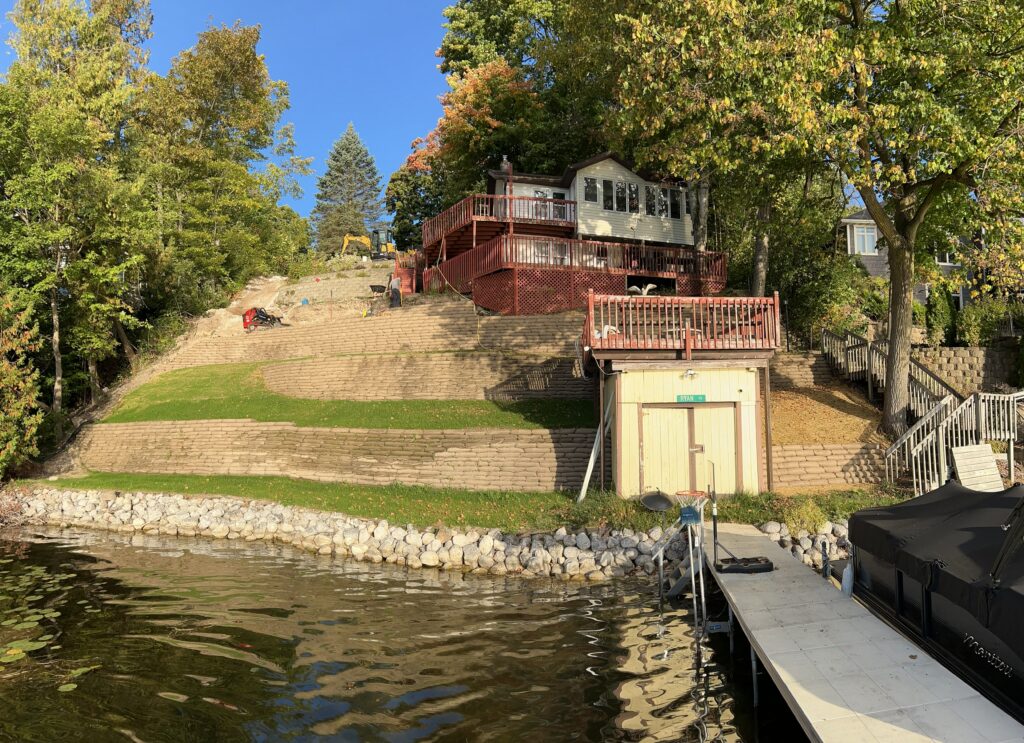
Lakefront slopes need a different approach because the water table, the wave action at the toe and the access for machinery all change the problem. A terraced solution often works better on a lake slope than one tall wall.
Terracing breaks the grade into stages, reduces the load on any single structure and leaves usable ground between the levels, which is generally what a property owner wanted from the slope in the first place.
Should a Retaining Wall Be Designed With the Rest of the Landscape?
A retaining wall should be designed with the rest of the landscape, because a wall changes the grade, and changing the grade changes drainage, planting and circulation above and below it.
Our wall design is coordinated with the landscape design rather than drawn separately, so the structure belongs to the plan instead of interrupting it.
Having a Retaining Wall Builder Read the Slope First
Picking a wall system before anyone has read the grade, the load and the drainage is how a property ends up with the wrong wall built correctly.
Contact Stuart’s Landscaping to have a site reviewed in Fond du Lac or across the Fox Valley.
In Summary
Can a retaining wall be built on a lakefront property in Wisconsin?
A retaining wall can be built on a lakefront property in Wisconsin, and terracing is often the better answer than a single tall wall, because it breaks the grade into stages and leaves usable ground between the levels. Shoreline work brings its own access and approval considerations, so Stuart’s Landscaping raises them at the site review rather than at quoting stage.
Does a vegetated wall need different maintenance than a block wall?
A vegetated wall needs establishment care rather than ongoing repair. The planting has to take hold before the system is doing its full job, so the first seasons matter most. After that a vegetated wall generally asks less of a property owner than a structure that relies on drainage alone.
How much of the cost of a retaining wall is hidden behind it?
A larger share of retaining wall cost sits behind the face than most people expect. Excavation, base preparation, drainage aggregate and reinforcement account for much of the work. Two quotes that differ sharply are usually differing on that buried portion rather than on the stone or block.
Related: Modern Materials & Finishes Homeowners Love for Retaining Wall Installations in Waupun, WI