

What a Landscape Lighting Installer in Fond du Lac, WI Does Before the Ground Closes
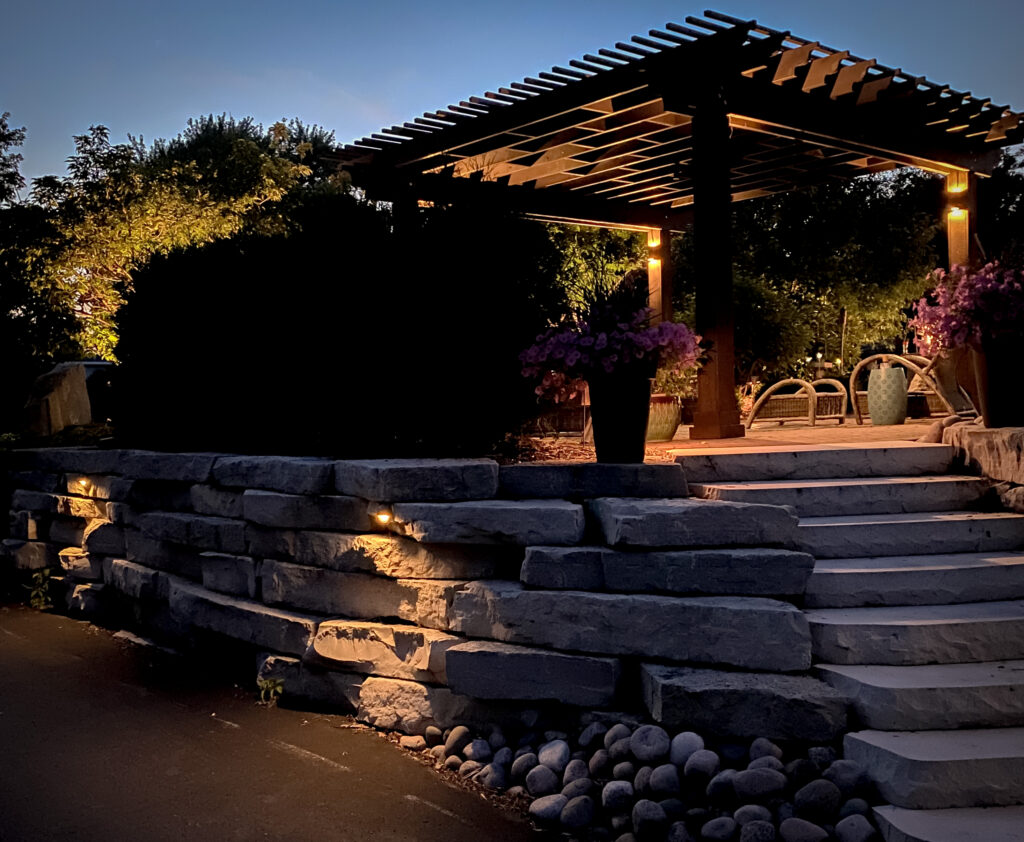
A landscape lighting installer in Fond du Lac, WI is working against a calendar that has nothing to do with the holidays. Cable has to go in the ground, and the ground here stops cooperating in November.
Unlike seasonal decor that comes down in January, a low-voltage system stays in the ground year-round, which is exactly why its installation and its durability are different conversations.
Almost every durability question about a permanent system is settled during installation. What happens in February is decided in September.
Stuart’s Landscaping & Garden Center has installed landscape lighting across Fond du Lac, Green Lake and the Fox Valley for decades. We size transformers correctly, route cable cleanly, and use warm color temperatures with beam spreads that highlight architecture and focal plants.
Related: Why Fond du Lac, WI, Homeowners Book Holiday Lighting Installation Before November
Why Does Wisconsin Ground Set The Installation Schedule?
Because the work involves trenching, and frozen ground does not trench. Once frost sets in, cutting a cable route through a bed stops being a spade job, and the turf takes far longer to recover. That gives the season a practical end date.
An autumn install also has an advantage. The beds are cut back, the perennials have died down, and a crew can reach the ground it needs without fighting summer growth.
Depth is the other thing the climate decides. Low-voltage cable is legally permitted at a shallow depth, which in a hard-frost climate is the depth at which a spade, a bed edger or the frost itself finds it.
Taking cable down to a consistent depth along a planned route, rather than laying it at whatever depth the ground allows on the day, is one of the differences between a system that stays quiet for a decade and one that produces an intermittent fault every second spring. Our low voltage lighting work treats the route as part of the design rather than as an afterthought.
How Do Fixtures And Connections Survive A Wisconsin Winter?
Path and step fixtures survive snow removal by being sited out of the way of it, which is a placement decision made months before the first snowfall. A path light set at the edge of a walkway is directly in the line of a shovel and squarely in the path of a plow blade throwing snow off a drive.
Setting fixtures back from the working edge, favoring recessed lights built into wall faces and step risers, and marking anything near a plow route keeps the system intact. This is the single most common cause of fixture damage in this part of Wisconsin, and it is entirely avoidable.
Freeze-thaw finds every joint that was made carelessly. Water works into a connection, expands as it freezes, and opens the seal a little further each cycle until the joint corrodes and the run goes dark.
The defense is unglamorous: properly rated waterproof connectors at every splice rather than twist caps and tape, fixtures with sealed housings, and connections made above the point where standing water collects. Brass and copper handle the cycling better than plastic and develop a patina rather than becoming brittle.
Related: Once You Add Outdoor Lighting in Fond du Lac, WI, You’ll Use Your Yard More
What Does A Permanent System Give You In December?
Usable daylight hours you would otherwise lose entirely. It is dark here before half past four in midwinter, which means the walk from the car to the door happens in the dark for months, often over ice. Lit steps and a lit entry is a safety argument long before it is an aesthetic one.
The rest of it is that a landscape under snow, uplit, is one of the better things a property does all year, and it costs nothing extra once the system is in.
Get The System In Before The Ground Closes
Stuart’s Landscaping designs and installs permanent low-voltage lighting across Fond du Lac, Green Lake and the Fox Valley.
If lighting has been on the list this year, the window for trenching it in without a fight is open now and shuts with the frost. We will walk the property, plan the routes and the fixture positions around your snow-clearing pattern, and give you a specification that says what is going on in the ground.
In Summary
What lighting work is still possible after the ground has frozen?
Fixture replacement and above-ground adjustments remain workable through winter. New cable routes are a different matter, since trenching frozen ground damages turf and planting far more than the same work in autumn and takes considerably longer.
Do fixtures need to be removed for the winter?
A permanent low-voltage system is built to stay out, which is the main thing separating it from seasonal decor. The winter task is keeping snow off lens faces where it accumulates and checking that nothing has been struck during clearing.
What makes a lighting system easy to extend later?
A transformer sized with headroom at the start. That is worth specifying up front, because a transformer chosen to exactly match today’s fixture count is the thing that makes a later addition expensive.
Related: What to Look for in an Outdoor Lighting Company in Fond du Lac, WI