
Fire Pit Builder in Fond du Lac, WI: Where the Fire Pit Lands in the Plan
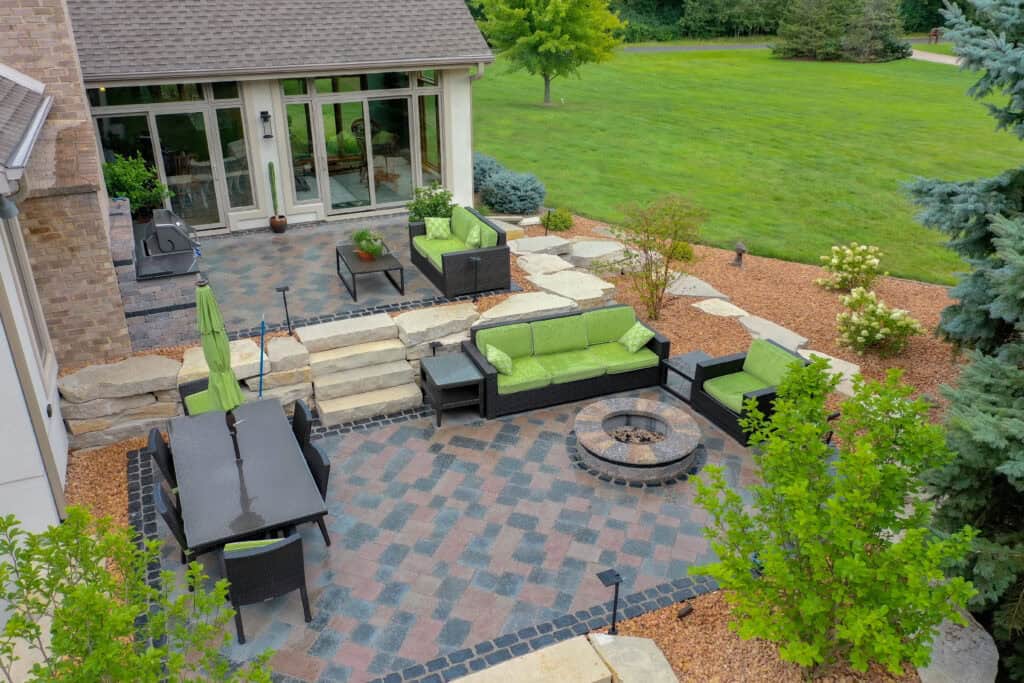
Drawings settle a fire pit long before a single unit gets set. Homeowners hire a fire pit builder in Fond du Lac, WI expecting a discussion about the pit, and the useful conversation turns out to be about the twenty feet around it: seating, walking routes, wind, and how the terrace reaches the house.
Stuart Muche founded Stuart’s Landscaping in the spring of 1986, and four decades of Wisconsin projects is what shapes how a fire pit gets placed.
Our patios and fire pits service treats the feature as one element of a larger plan, which is why the design comes first. A pit added to a finished terrace ends up wherever there was room rather than where it works.
Related: Using Focal Points in Landscape Design to Create a More Inviting Outdoor Space
Why Does A Fire Pit Belong On A Landscape Plan Rather Than Added Later?
Because the pit dictates the terrace, not the reverse.
A seating circle wants a defined area with a border that visually separates it from the dining zone, and that border gets laid during construction.
Retrofitting a pit onto an existing terrace leaves the seating cramped against a table, the border pattern interrupted, and the walking route running straight between the chairs and the fire.
It also costs twice. The area gets cut, reset and re-compacted, and replacement pavers rarely weather to match the field around them.
What Does The Design Stage Actually Produce?
The design work moves through three stages: a concept sketch, then a two dimensional master plan, then a three dimensional rendering where it helps.
That progression lets a homeowner see the seating circle at real scale before committing, and it catches the problems that are obvious on paper and expensive on site.
Grade changes, downspout outlets and the position of a gas or electrical run all get resolved here, while moving them is a pencil line rather than a machine.
Which Stone Suits A Fire Pit In East Central Wisconsin?
Regional material reads best. Wisconsin granite boulders bring a rustic weight that suits a lakefront lot.
Chilton limestone carries warm earthy tones and texture. Lannon stone gives a cleaner classic look with strong visual impact.
Because we grow and source material through our own garden centers and tree farm, matching stone and planting across a whole property is a practical decision rather than a special order.
The stone also has to survive being heated and frozen in the same year, which rules out softer material that photographs well and holds up poorly.
Related: Transform Your Outdoor Living With Expert Landscape Design in Waupun, WI
How Far Should A Fire Pit Sit From The House And The Seating?
Far enough that smoke and heat clear the structure, close enough that people use it.
On most Fond du Lac lots that means well clear of eaves and any timber structure, with prevailing wind considered so the seating on the sheltered side stays comfortable.
Chairs sit roughly three feet back from the edge, and a clear route runs behind them so nobody steps between someone and the fire.
What Does A Wisconsin Winter Ask Of A Fire Pit Build?
Mostly it asks for drainage.
Water sitting in a base through repeated freeze and thaw cycles is what moves units out of line, so the terrace under and around a pit wants a properly drained base and a surface that sheds water away from the seating area.
Snow removal matters too. A pit set flush in a paver field is far easier to clear than one surrounded by loose stone, which a shovel scatters across the terrace every time.
Put A Fond du Lac Fire Pit On Your Landscape Plan
The pit is the easy part. The terrace, the seating circle and the route to the house are what make it get used, and those belong on a drawing.
Stuart’s Landscaping designs and builds fire pits as part of complete patio and outdoor living plans across Fond du Lac, Green Lake and the Fox Valley, and a design consultation this fall puts a spring build within reach.
In Summary
How much space does a fire pit seating circle need?
A comfortable seating circle runs around eighteen to twenty feet of diameter once chairs and a walking route behind them are included. Squeezing the same circle into twelve feet puts people close enough to the fire to be uncomfortable and leaves nowhere to pass, which is why the terrace gets drawn before the pit is priced.
Is fall a reasonable time to plan a fire pit for next year?
Fall is the sensible time to start. Design work through fall and winter means a plan is approved and scheduled before spring, when installation slots fill quickly across east central Wisconsin. Sketching in April means building later in the season than a homeowner hoped.
Which stone reads as local in a Fond du Lac landscape?
Wisconsin granite boulders, Chilton limestone and Lannon stone all appear in the region’s older walls and outcroppings, so they sit naturally alongside a fire pit here. Stuart’s Landscaping matches the pit to stone already used elsewhere on the property wherever that is possible.
Related: Transforming Outdoor Living with Landscape Design and Pergolas in the Town of Empire, WI